2025 US snack sales decline as consumers shift to grocery staples — I know this feels urgent: declining snack velocity, margin pressure and SKU decisions are disrupting forecasting and shelf strategies for category teams.
What happened in 2025: headline moves and primary drivers
Snacking weakened across the market as consumers reallocated spend to grocery staples (meats, eggs, produce) and lower-cost options. Public-company disclosures show the impact: Mondelēz reported North American net revenues down 4.1% and warned consumer confidence won’t rebound quickly; PepsiCo’s North American foods organic revenue slipped about 2% with Frito-Lay volumes down roughly 3% in its most recent quarters; J.M. Smucker reported a 7% decline in sweet baked snacks; General Mills cited a mid-single-digit sales decline. A NIQ February survey found 42% of consumers saying they buy fewer snacks because of high prices.
Key demand drivers, synthesized from market studies and corporate commentary:
- Pantry normalization after pandemic-driven restocking reduced repeat snacking buys.
- Inflation and value-seeking shifted trips toward staples and private label.
- Health and wellness behavior — including documented GLP-1 adoption effects — lowered impulse snacking for some households (EY estimates a potential long-term impact of about $12 billion on snack foods; Cornell/Numerator found households with a GLP-1 user cut savory snack purchases 11% within six months).
- Fewer on-the-go occasions as out‑of‑home snacking remains below pre-pandemic patterns.
These forces combined to create a lower-frequency, lower-volume snack demand environment with pockets of resilience in value tiers and health-forward SKUs.
Category decomposition: where the losses concentrated
Across available company and industry signals, the declines were not uniform.
- Chips and savory snacks: core volume softness was reported by major players (Frito-Lay volumes down about 3%), making chips a principal contributor to overall category decline.
- Sweet baked goods and cookies/crackers: saw pronounced softness in several company reports; J.M. Smucker’s 7% fall in sweet baked snacks is illustrative of mid- to high-single-digit weakness for parts of this subcategory.
- Candy/confection: mixed, with impulse channels (c-stores, checkout) hit harder as shoppers cut impulse buys.
- Nuts, jerky and premium “better-for-you” snacks: more resilient or modestly growing as consumers trade down frequency but trade up in perceived value/health for occasional purchases.
- Single-serve impulse versus multipack: single-serve and premium impulse formats declined faster; value multi-packs held relatively better for pantry replenishment occasions.
Taken together, company disclosures point to total category revenue declines concentrated in the traditional impulse segments while some multipack/value and health-forward niches outperformed.
Price versus volume: what drove revenue changes
Available scan and company data indicate volume declines accounted for the majority of revenue losses, with price/mix partially offsetting the drop:
- Example signals: Frito-Lay volume down roughly 3% while PepsiCo’s NA foods revenue down approximately 2% — implying price/mix provided a partial cushion. Mondelēz’s North America revenues down 4.1% signal a heavier volume/mix hit in that business.
- Real (inflation-adjusted) sales fell for many snack lines once CPI food-at-home inflation is accounted for; consumers increasingly respond to nominal price points rather than accepting higher pack prices.
Category managers should decompose changes across:
- Nominal sales change (reported revenue)
- Unit-volume change (scan units)
- Price/mix change (average price per unit, pack-size shifts)
- Real sales (inflation-adjusted)
This decomposition clarifies whether losses are recoverable through promo and assortment or represent true demand erosion.
| Company / Metric | Reported change |
|---|---|
| Mondelēz (NA net revenue) | -4.1% (quarter) |
| PepsiCo (NA foods, organic revenue) | ~-2% (quarter); Frito-Lay volumes ~-3% |
| J.M. Smucker (sweet baked snacks) | -7% (Q3) |
| General Mills (Q3 net sales) | -5% |
How retailers and channels responded
Retailer behavior reinforced the shift toward staples and value:
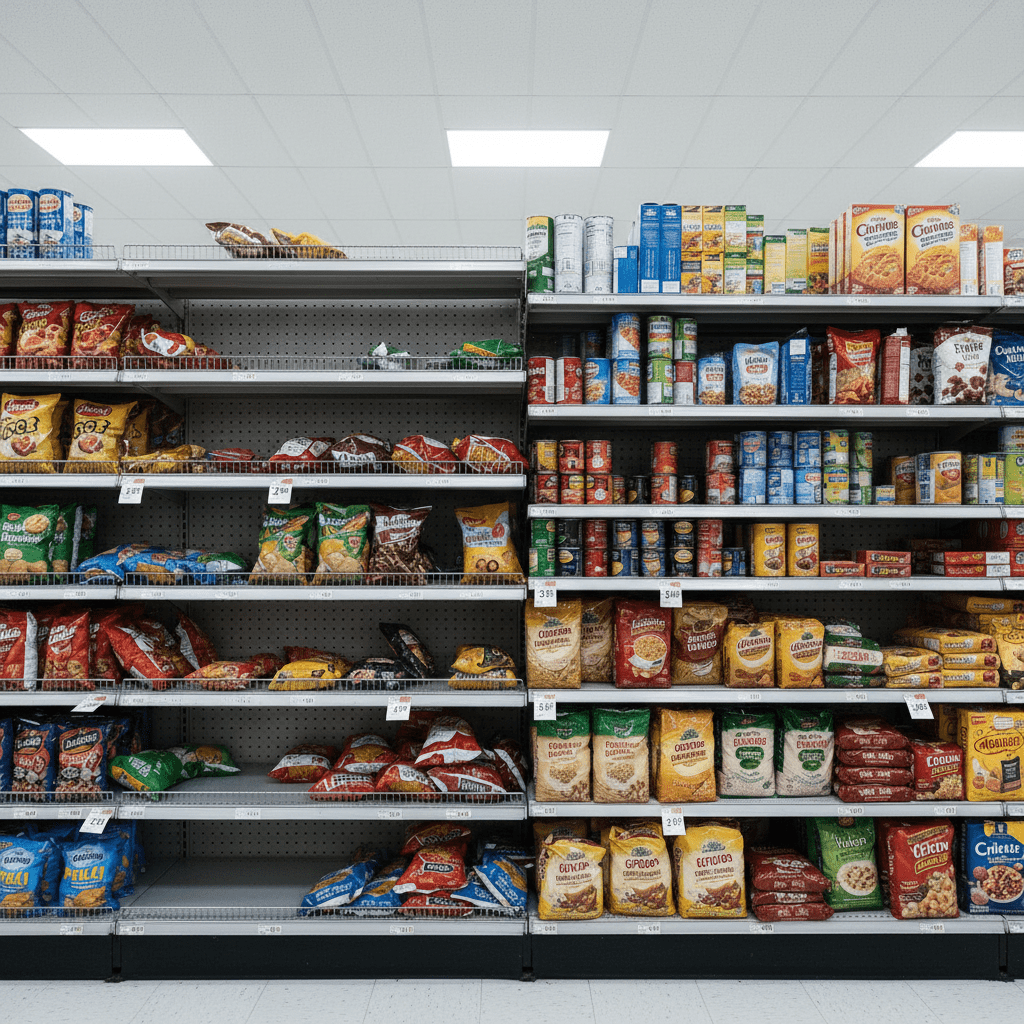
- Assortment rebalancing: retailers prioritized space for staples and private-label expansion, and tightened low-velocity snack SKUs to regain productivity per square foot.
- Promotion cadence: many chains reduced promotional depth/frequency in late 2024–2025 to protect margins, while redirecting targeted promos toward value tiers.
- Channel divergence: club and mass channels showed higher movement on multipacks/value formats; c-stores and impulse locations experienced sharper declines due to fewer out‑of‑home occasions; e-commerce grew for subscription and bulk pantry buys.
For category managers, that means monitoring private-label share points closely and reallocating merchandising toward SKUs that preserve trip frequency and turn.
Manufacturer responses and strategic levers
Snack manufacturers moved on multiple fronts:
- Portfolio and pack engineering: SKU rationalization, smaller single-serve or low-price formats (PepsiCo rolled out items under $2; Mondelēz emphasized items under $4) and multipack value options.
- Product innovation and positioning: accelerate health-forward and functional claims (protein, fiber, cleaner labels) while testing premium formats that justify higher prices.
- Cost and supply moves: aggressive cost takeout, sourcing optimization and use of AI/predictive analytics to tighten forecast accuracy and cut working-capital exposure.
- Trade and promo reallocation: shift trade spend to higher-ROAS SKUs and more surgical in-store/promotional tactics.
EY and other advisors note the GLP-1 adoption effect is an added structural risk; companies are balancing short-term promotional defense with longer-term NPD that targets value and health trade-offs.
- Immediate tactical recommendations for category managers:
- Update elasticity and promo-response models now using 2024–2025 scan data and scenario stress tests.
- Prioritize high-ROAS SKUs and reduce low-productivity SKUs; target shelf-space to best-selling value and health-forward items.
- Run controlled pricing and pack-size experiments (A/B tests across stores/channels) to isolate price elasticity and trade-up potential.
- Tighten forecast scenarios (base / soft / hard) and increase short-horizon replenishment runs to avoid overstocks.
- Monitor private-label share weekly and coordinate with merchandising on defensive promotions for branded SKUs.
Forecasts, leading indicators and investor implications
Near-term outlook: expect continued headwinds into 2025 with recovery dependent on several indicators:
- Food-at-home CPI trend: falling CPI would relieve nominal pressure and could restore some snack demand.
- Pantry restocking index and grocery trip frequency: rising frequency would signal returning purchase occasions.
- Dine-out recovery and out-of-home occasions: more eating out generally increases impulse snacking outside the home, supporting certain formats.
- GLP-1 adoption stabilization: if large-scale behavioral impacts persist, the category faces structural demand reduction for impulse/high-calorie snacks.
Implications:
- Margin pressure and slower top-line growth may persist, favoring firms that quickly optimize mix and cut costs.
- Investors should expect elevated near-term revenue risk but differentiate companies with data-driven supply chains and defensible premium/health portfolios.
KPIs to track weekly/monthly: YOY sales %, unit change %, real (inflation-adjusted) sales change, promo % of sales, private-label share-point change, SKU productivity (sales per SKU), and scenario-based forecast accuracy.
Conclusion
The 2025 US snack sales decline reflects a mix of cyclical normalization and structural shifts: inflation-driven trade-down, pantry normalization, health-driven behavior changes and fewer impulse occasions. For category managers and retail buyers the priority is immediate, data-driven action — tighten forecasting, reallocate shelf space to high-velocity value and health-forward SKUs, and run short, controlled pricing and pack experiments to measure elasticity. Executing these levers swiftly helps protect margin, preserve shelf productivity and position brands to capture recovery when leading indicators turn.